Applications
Two connected pathways
ORH proposes an industry-first route to piloting and validation, with humanitarian and community use as a longer-term possibility dependent on successful research, piloting and validation.
Early adopters
Industry applications
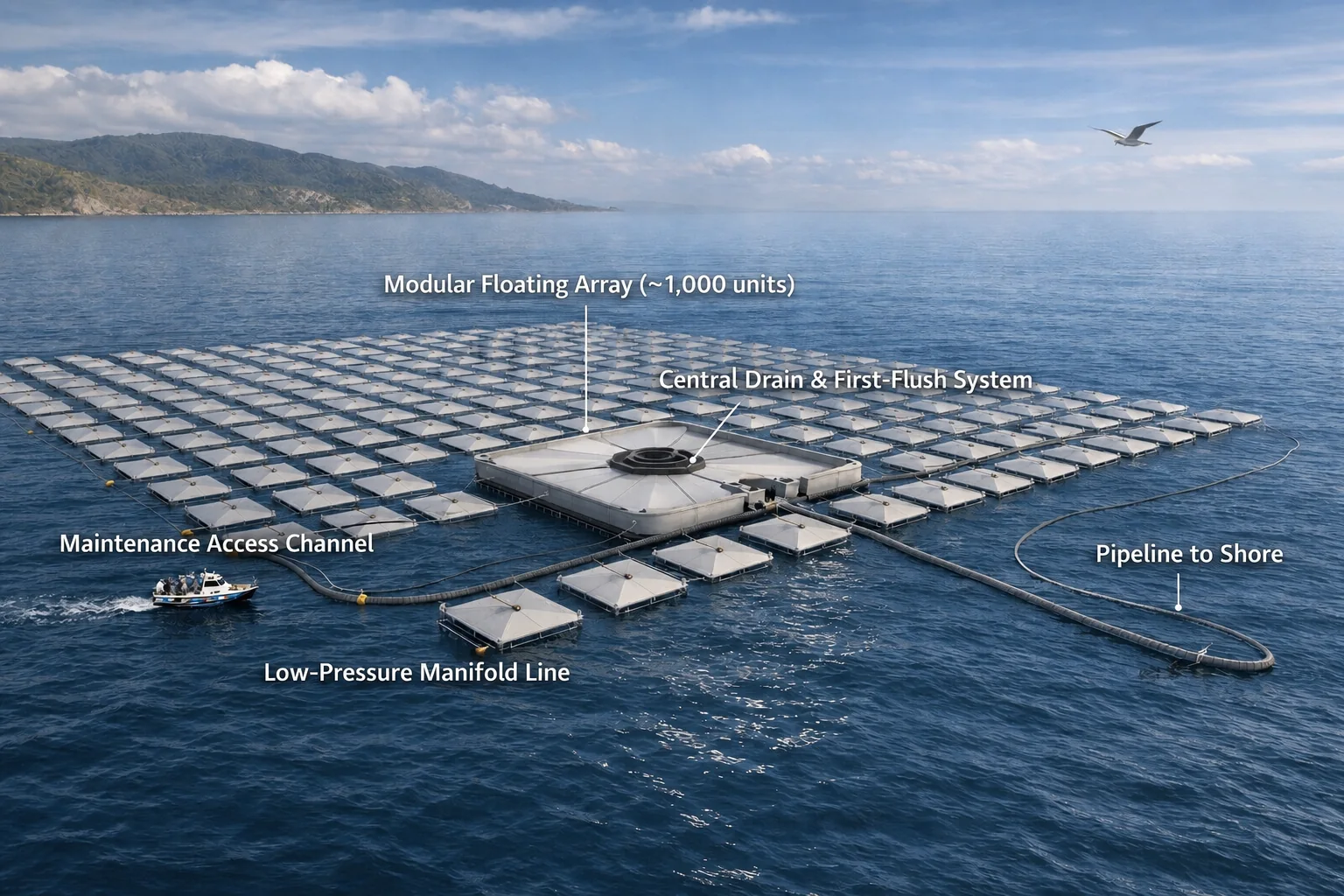
Coastal industries, including data centres, ports, industrial parks and marine-adjacent facilities, increasingly require reliable, low-mineral water for cooling and processing. Offshore rainfall arrives with exceptionally low dissolved-solid content, producing naturally soft water that reduces scaling and lowers treatment requirements.
ORH continues producing water during:
Its modular, low-energy design avoids high-pressure membranes and continuous chemical dosing, offering a nature-based supplementary source that strengthens operational resilience and supports ESG commitments.
Industry participation provides the pilot data, performance validation and commercial traction needed to refine the concept before wider deployment.
Long-term pathway
Humanitarian & community applications
In many low-income coastal regions, access to safe water is limited not by rainfall, but by the cost and complexity of conventional treatment systems. Offshore rainfall arrives naturally clean, requiring only simple filtration and disinfection, avoiding high-pressure membranes, continuous chemical supply chains and specialist operators.
Because ORH operates independently of grid power, it can continue functioning during outages, storm damage or periods when municipal plants cannot run. Its simplicity, modularity and low energy demand make it a practical supplementary source that strengthens resilience for communities facing chronic constraints.
ORH is not a replacement for municipal supply, but a dependable buffer that safeguards essential water access during periods of vulnerability.